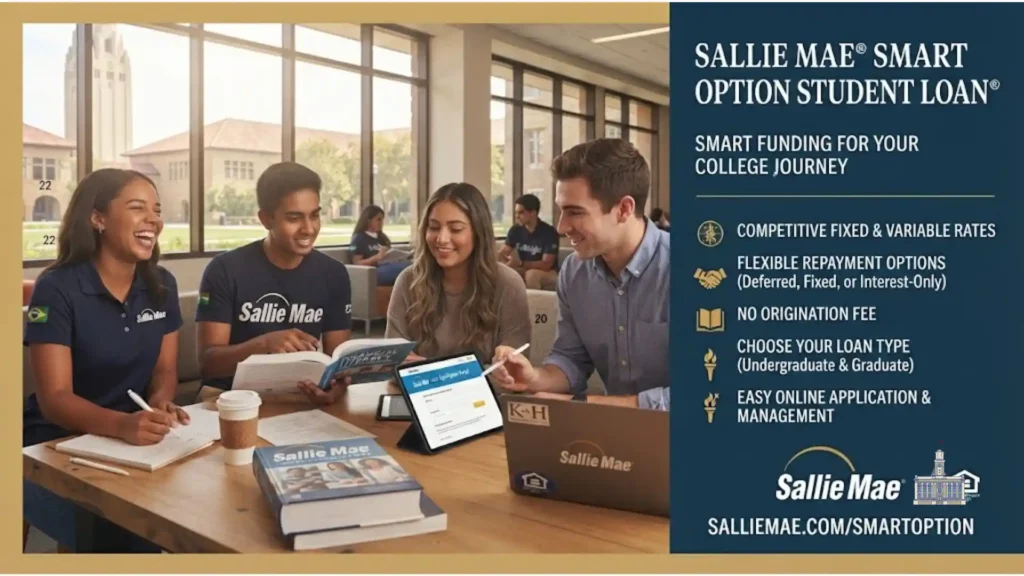
The Sallie Mae Smart Option Student Loan is a private, non-federal credit instrument issued by Sallie Mae Bank, a depository institution regulated by the Federal Deposit Insurance Corporation (FDIC) and Utah’s Department of Financial Institutions. Unlike Title IV federal student loans authorized under the Higher Education Act, private student loans are commercial underwriting vehicles.
Get More Information About The Fulbright Foreign Student Program
Explore more info.
Because these loans do not utilize federal subsidies or formulas, eligibility is determined by private creditworthiness and commercial underwriting guidelines. This program serves undergraduate students enrolled at least half-time at participating degree-granting institutions, offering borrowing limits starting at $1,000 up to 100% of the school-certified COA.
2. Underwriting Criteria and the Role of Cosigners
Private student lending is heavily reliant on risk-based pricing and individual credit profiling. To qualify for a Sallie Mae Smart Option Student Loan, applicants must meet strict underwriting standards, including credit history evaluations, debt-to-income (DTI) ratio verifications, and employment history audits. Because the vast majority of undergraduate students possess limited credit histories and minimal personal income, approximately 90% of undergraduate private loans require a creditworthy cosigner.
A cosigner assumes equal, joint legal responsibility for the debt. The credit profile of the cosigner primarily dictates the loan’s final interest rate, and a stronger profile yields lower interest rates. Under Sallie Mae’s guidelines, borrowers may apply for a «cosigner release» after graduating, making 12 consecutive, on-time monthly payments of principal and interest, and meeting the bank’s independent underwriting criteria on their own.
3. Variable vs. Fixed Interest Rates and Origination Costs
The Sallie Mae Smart Option Student Loan does not assess an upfront origination fee, which contrasts with the statutory fees required by federal Direct PLUS loans. However, the interest rate structures are subject to market fluctuations. Borrowers must select between a fixed interest rate (which remains constant over the life of the loan) and a variable interest rate (which fluctuates based on a benchmark index, typically the Secured Overnight Financing Rate, or SOFR).
Interest on these private loans begins to accrue immediately upon disbursement. While federal subsidized loans hold interest liabilities in abeyance during enrollment, private credit instruments continuously compound interest daily. This means that deferring payments while enrolled causes the unpaid accrued interest to capitalize at the end of the grace period, significantly inflating the outstanding principal balance.
The following data analysis contrasts the financial outcome of borrowing $15,000 under a fixed rate of 9.50%, comparing the three in-school repayment options offered by Sallie Mae.
In-School Repayment Structures: $15,000 Private Loan (9.50% Fixed Rate, 48-Month Enrollment)
*Note: Calculations reflect simple interest accrual over a 4-year undergraduate enrollment period plus a 6-month grace period before amortization.
Repayment Flexibilities and Amortization Schedules
Sallie Mae structure options offer three primary paths to interest management while in school:
- Interest Repayment: The borrower pays the interest charges monthly while enrolled. This stops interest capitalization completely and ensures the post-grace principal remains equal to the starting amount.
- Fixed Repayment: The borrower pays a flat fee of $25 per month while enrolled, which partially covers accrued interest. Unpaid interest accumulates and capitalizes when full repayment begins.
- Deferred Repayment: The borrower makes no payments during school or the grace period. This maximizes short-term cash flow but leads to the highest lifetime cost due to full interest capitalization.
Sallie Mae amortizes loans over standard repayment periods of 5 to 15 years, depending on the borrowed amount and undergraduate status. Unlike federal loans, private student loans are not eligible for federal Income-Driven Repayment (IDR) plans or Public Service Loan Forgiveness (PSLF). If a borrower faces severe financial hardship, Sallie Mae may offer temporary interest-only modification programs or brief periods of forbearance, but these options are governed by internal corporate policies rather than federal statutes.
| Operational Feature | Sallie Mae Smart Option | Federal Direct Student Loan |
|---|---|---|
| Interest Rate Bases | Fixed OR Variable rates available | Strictly Fixed rates set by Congress |
| Borrowing Caps | Up to 100% of Cost of Attendance (COA) | Statutory annual and aggregate limits |
| Cosigner Requirement | Typically required for undergraduates (90%+) | Not required (except for PLUS adverse credit) |
| Origination Fee | None (0% administrative charge) | 1.057% (Sub/Unsub) to 4.228% (PLUS) |
| Repayment Relief | Discretionary private forbearance | Statutory IDR plans and PSLF eligibility |
Case Studies and Verified Student Outcomes
The following documented cases provide real-world insights into how borrowers utilize Sallie Mae Smart Option Student Loans to bridge financial gaps. These profiles highlight the impact of cosigners and the benefits of proactive interest management.
«Applying with my father as a cosigner secured a fixed interest rate much lower than standard variable offers. Choosing the $25 monthly payment during school helped us keep the final capitalized balance manageable.»
Katherine O’Connor
Philadelphia, PA • B.S. in Biology
«I paid the full interest monthly while completing my engineering program. Graduating without any capitalized interest saved me over $4,000 on my loan’s total cost, and I met the criteria to release my cosigner after 12 months.»
Julian Ramirez
Denver, CO • B.S. in Civil Engineering
«The application was straightforward, and we chose a variable SOFR-linked rate. While market shifts carry risks, the zero upfront origination fee allowed us to maximize the funding sent directly to my university.»
Tariq Al-Mansoor
Austin, TX • B.A. in Economics
Application Protocols and Disbursement Coordination
To initiate a Sallie Mae Smart Option Student Loan, applicants should first exhaust federal financial aid options by submitting the FAFSA. If private funding is required, the borrower and cosigner apply through the Sallie Mae online portal, where they authorize credit checks and submit income documentation.
Once approved, the school must certify the loan’s alignment with the student’s Cost of Attendance (COA) before Sallie Mae sends the funds directly to the institution’s billing office.